What is an AI operating system?
The term AI operating system comes up more and more. But what exactly is behind it, and which problems does an AI operating system solve?

The term “AI operating system” (“AI OS”) has been used more and more lately. But just as not everything labelled “AI agent” actually contained AI agents, it is no different with the AI operating system: simple chat platforms are called operating systems, simple LLM chat is called an AI agent. So what makes a “real” AI operating system?
First of all: the term is not a standard yet
The term is (as far as I know) not a standard yet. And as with AI agents, the answer changes depending on who you ask. Before getting lost in requirement catalogues, the more important question is probably: Which problems is an AI operating system supposed to solve?
Which problems should an AI operating system solve?
Here, too: there is no fixed definition of which problems an AI operating system should solve. But in my opinion, these problems arise from the way how AI has been implemented so far. They are surely also a large part of the reason why AI projects fail so often or do not deliver the results that were hoped for when they were introduced.
Missing overview
Sure: shadow AI. Everyone starts running off, buying, downloading, building. And after four years, you are where you are now: a web of isolated solutions, unclear responsibilities. Where does the data flow to? Are the solutions GDPR compliant? What do we already have, what do we still need? And so on and so forth.
Even though the problem points strongly to the topic of AI strategy, that is only half the truth. Without a solution that makes a good strategy possible in the first place, the strategy can be as visionary and conceptually brilliant as it likes. Alongside the organisational solution, it takes a technical solution just as much, one that supports and enforces the rules and the strategy not by PDF, but by CPU.
A central place for all apps, all rules, all agents was still utopian for most a few months ago. But since Claude and others have been introducing one brilliant “app” after another, in one beautiful, unified platform where the components interact and complement each other, no, even lift each other up, it should have become clear to many: this is not only possible, it is necessary. Because in my opinion, the supreme discipline of AI is the synergy between the individual solutions, and that does not emerge between islands.
But is it also necessary to lock yourself into someone else’s platform for this?
Solution Stay platform independentCopilot, Claude, your chat platform: your tools connect to ZiyaOS once. Switch platforms without reconnecting anything.Missing permission concept
Another problem is the lack of permission concepts that apply across solutions, are controlled centrally and apply equally to agents, apps, workflows and users (roles & permissions). Sure, SSO, SCIM and taking over group permissions are important building blocks in all of this. They are necessary, however, but not sufficient on their own.
Missing cost control
On the one hand a good indicator that AI adoption in the company is apparently rising, on the other hand a painful topic, especially when the overview and central mechanisms of cost control are missing or can only be enforced with a lot of extra effort.
Many systems also ignore important methods of token cost saving. Maybe because they overlook them or have other priorities. But maybe also because the interests of the solution providers do not match yours: whoever bills per token has little incentive to lower your consumption.
DIY and insecure vibe coding
One of possibly the biggest advantages of the AI revolution is the democratisation of skills that are (for some) hard to learn, programming in particular. With tools like Claude Code and OpenAI Codex, employees who are in the middle of chaotic processes and are actually predestined to build the perfect solutions are now able to implement them conceptually, too.
However, the same issues arise here as with external solutions: missing overview of the sprawl, missing control of permissions and missing cost control. With the addition that here, too, responsibility is missing or is handed to employees who should never be in charge of topics like IT security and data protection. On top of that, such vibe-coded solutions often lack the means for a proper connection to existing systems as well as for distribution or deployment, i.e. making them available to other employees (with the right permissions – there is that topic again).
And although these vibe-coded solutions solve the problems of many companies perfectly, precisely because they were designed by those who know the problem better than most external consultants ever could, here, too, there is no solution that enables their secure and scalable operation.
Solution Secure vibe codingSecure AI-built apps after the fact: rules, approvals, budgets and an audit trail.More problems and their implications
There are many more problems I have not gone into here:
- Agents that are allowed to call out to the internet, without a firewall. Who thought it was a good idea to allow that without logging, oversight and rules?
- Local AI that cannot be run sensibly and at scale.
- No central portal for approvals with mechanisms like human in the loop, i.e. human oversight and mandatory approval for certain actions of agents, workflows and apps.
And the implications? More and more solutions that are bought and run uncontrolled. Ticking time bombs for GDPR lawsuits (writing that out already hurts). Cost explosions waiting to happen. Frustration among employees: on the one hand about the countless isolated solutions, on the other hand about the lack of the solutions that would really lift them up, i.e. that would enable them to solve their problems themselves, in a targeted way.
But it is slowly time to get to the original question: what is an AI operating system, and how does it solve these problems?
How does an AI operating system solve these problems?
Exactly the way you would expect. My requirement for an AI operating system is to solve the problems above sensibly and in one sustainable system.
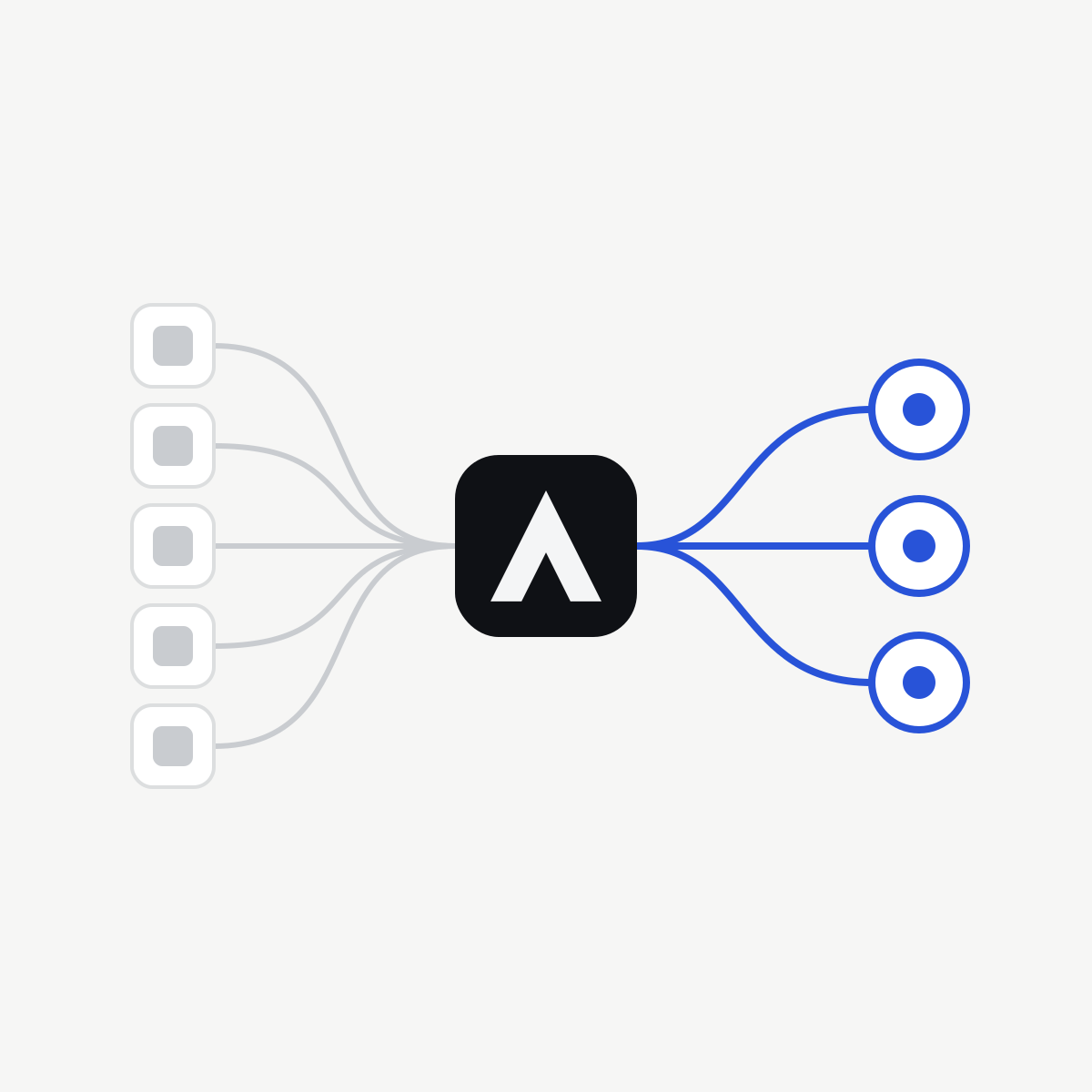
Instead of connecting 100 apps to 100 integrations (10,000 custom connectors, permission concepts etc.), you would rather have one system with 100 integrations that 100 apps can connect to.
Feature GatewayOne access key per agent: Claude Code, Codex or your own agents reach your connections over MCP, with the same rules as internal agents.At this node, the permissions for every app and every integration, for every user and every agent are also set centrally and clearly. The company’s SSO, group structure and other permission concepts connect at this point, too.
And once you have such a point, cost monitoring and cost control are taken care of as well. Limits and budgets are assigned centrally, once, right here. Additional safeguards can set upper limits on the individual apps and integrations, but fine-grained limits – weekly, monthly, per person, per group or for the whole company – are controlled here.
It is also the foundation that secured sandboxes can connect to, in which your employees’ useful vibe-coded apps run. And only at such a shared node can the individual solutions really work together: this is where the synergy comes from that I consider the supreme discipline of AI.
It solves numerous other problems in one go, until you ask yourself: why did anyone ever try to do it differently?
What an AI operating system is to us
And that is exactly what an AI operating system is to us: the missing piece of a successful AI transformation for companies today. The component that clearly separates what is feasible from what can be justified. The component that breaks bottlenecks and truly empowers employees. The component that can really deliver AI adoption and democratises AI safely.
We are excited about this step and also about providing exactly this solution with ZiyaOS: secure, sustainable, transparent and above all sovereign, in Germany or on-premise at your site.